That was Riga…
Herman D. Neudorf lived since the year 1938 in Gelsenkirchen-Horst. Then the National Socialists abducted him. Seven years of his young life he had to spend in the ghettos and concentration camps. It was hell on earth. In his email to GELSENZENTRUM dated in August 2007 Herman Neudorf wrote: “I often wonder that I survived this awful years.” Herman D. Neudorf crafted a collage after he was delivered out of the KZ Buchenwald.
Deportation of Polish Jews
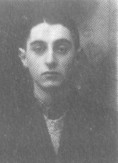
It was October, the 28th in the year 1938. I was just 13 years old when I became arrested by the Gestapo during my school lessons. They brought us to a jail in Gelsenkirchen. In this jail I met my mother. Therefrom, we were sent to Poland. We had nothing to take with us. My mother was arrested when we made our way to the market. She just had her handbag with her. My father was told that only males would be arrested. This message he got from a phone call from Essen. Only Polish-Jewish males would be arrested. The females were left behind. Caused of this reason he went to the Polish Consulate in Duesseldorf to obtain papers. Because he was gone, we became arrested. When he came back we have been already located at the German-Polish border. We were thrown out by the Germans and the Poles did not allowed us in.
It was in the end of October. It was cold outside and we had nothing neither blankets nor coats. We camped in front of schools, lay on straw. There was nothing but a telephone. We could call our relatives, grandfather, grandmother and aunts, in Poland. We could tell them where we have been. They sent us money for a rail ride to meet them and finally they admitted us. We got in touch with my father and he came to visit us in Poland in the end of the year. His mother died a natural death. We went to the funeral and been altogether now. Then my father and my mother got the permission to go back to Germany. They had to give up business because the Crystal Night took place, yet. I think it was in February 1939. Everything was destroyed. He went back to dissolve his business and we thought that we could emigrate. The difficulty of emigration especially to the USA was the Polish quote. This quote did not give us the chance to emigrate to the USA before the years 1943 or 1944. We wanted to go anywhere but it was impossible. We had no possibility to escape.
It was the first of September when the war started. I’ve been to Lodz, my parents in Germany. My father was arrested by antagonistic foreigners on September the second or third. He was brought into the KZ Sachsenhausen in the near of Berlin. My mother in Germany was on her own and I’ve been still in Lodz. I remember, the Germans invaded into Lodz in September, 8th. From then on everything changed dramatically.
The Jews became an unprotected game. They were grabbed, put on a truck and one hour later they didn’t know anymore what happened to the other people, their husbands, fathers and sons. The Jews were beaten or expelled. Many Poles were happy to get into positions the Jews had in before. The Jews could be treated as anybody wanted to. But this was just the beginning.
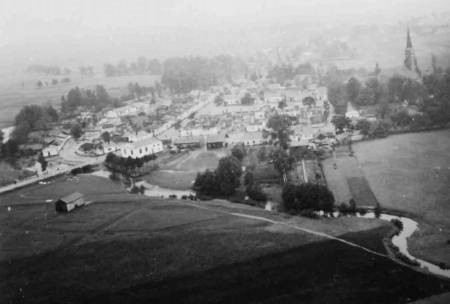 Picture: Look on Konski
I guess it was in January of the year 1940 when the Germans began to build the first ghetto: Lodz. In this time the name changed from Lodz into Litzmannstadt. I succeeded in leaving the ghetto just in the week when the ghetto was blocked definitely. My aunt and my uncle admitted me. In a horse carriage we drove together with some other people to a place named Konskie. It was a village apart from any towns and not hectic. You couldn’t find any ghettos. We stayed there till June of the year 1940. In a horse carriage we drove together with some other people to a place named Konskie. It was a village apart from any towns and not hectic. You couldn’t find any ghettos. We stayed there till June of the year 1940.
|
|
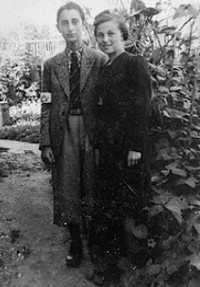
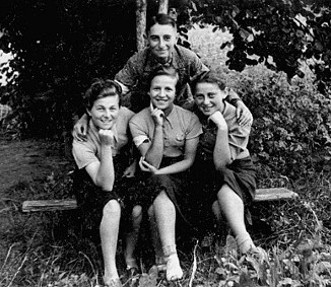
This pictures were taken in July 1940. It shows Herman Neudorf together with three good female friends beyond the ghetto of Konskie. The girl on the left picture was called Jadzia. On the right picture Jadzia is sitting on a bench (right). A few weeks later both girls were gassed in the death camp Treblinka.
|
Now, Herman is nearly in an age of 15
|
Top
↑
|
In the meantime his mother struggled to obtain permission from the Gestapo to get back her only son. I don’t know why and I don’t know any other cases but she obtained permission that I could return from Poland to Germany to live together with my mother.
In other words: In Lodz we had to wear the Yellow Star on our clothes ahead and behind. In Poland we got a white band with a blue star on our arm which allowed us to use the German train. It still sounds unbelievable: A Jewish boy was allowed to leave Poland and return to Germany with the German forces.
I went back to Germany in June 1940. After “The Crystal Night”, my mother and I were brought out of our lodging to a house of Jews. There I had to live together with my mother in only one room. We already had not to ware a star, could move freely and went to work. I took my meals at home. We got post from my father. Once a month he could write a card while he was in the concentration camp. We knew, all hell had broken loose. As a child I didn’t really knew how horrible it was. But my father wrote that he was okay. I wrote back to him. I also wrote to relatives that my father would come out of the concentration camp if he got a visa exhibited by any country.
Deportation to Riga
It was December, the 20th in the year 1941 when we got the first request from the Gestapo in Gelsenkirchen: “You have to brace you for a transport for working in the East. As baggage you can take with you 10 reichsmark. The travel costs have to be paid by you.” Everything that we acquired painful after the pogrom after November, 9th in 1938 should be left behind. Everything would be given to the rapacious Nazis.
My mother was sick. It shattered the nerves. It was too much since November, 9th. Everyday there are new torments. Overnight, we sank into poverty. Goods and chattels were destroyed or robbed. At the start of the war she was snatched from her husband violently because he was Pole and especially Jew. He was a public enemy. After waiting for weeks to get sign of life of him we received a greeting from the KZ Sachsenhausen. I’ve been to Poland and lived to see the attack of the Germans. The woman stood on herself. Husband and children have been far away in the hands of murderer.
After months of fight I had the chance to go back as her only child. When we saw us again we forgot the sorrow a bit. In the end of February my grandmother on my mother’s side died. After the week of grief a letter of my father arrived. I’m fine. I’m in good health. Be strong! Bear up! Hope to see you soon! We were very happy and I could see my mother laughing after a long time.
Two days later we had the memorable march, the 14th. It was 8 p.m. when the mailman rang the bell. He brought a telegram. I assumed it at the door and opened it quickly. What I read was terrible. I thought of my mother. I ran upstairs and went into her room white as salt. “Who was it?” I couldn’t talk. „What happened? What’s wrong with you?” I could just say “Mother, be strong.” Then I gave the letter to her. It was written that her husband died of pulmonary tuberculosis. The dead amber would send later. After all this awful months banish. Where should it end?
Top
↑
We made preparations. We purchased medications, antifreeze, winter clothes, and warm blankets and so on. In January 1942, 20th we got a new letter: "You have to keep ready for transporation to East in the next three days."
The time has come. It was January, 22th at 10 a.m. when we were collected by the Gestapo and been freighted in a bus. Only one baggage for each person was allowed. Many school children gathered around the car. They asked us where we are travel to and the chauffeur of the Gestapo answered: "To a sanatorium to relax."
At the meeting place we slept a night on the floor. Next day we continued the journey. The murderer knew where we go to. It was snowy and we had just -25 degrees Celsius. The train was ready. Inside the train is was very cold. At the end of the train there were three wagons where our baggage was putting in. We departed. The doors were closed. Near of Hannover we were told that the last wagon was overheated and had to be left behind. We just owned that what we were wearing. We traveled six days through East Prussia, Lithuania and Latvia. The toilets were clogged and the walls were frozen over. In February, 1st we arrived in our homeland.
We stopped at the station of Riga-Skirotava. The SS waited for us while wearing fur coats. They floated us with strokes and screaming out of the train. Our bodies were still frozen. We had to walk or to take cars. We had to march about three hours. Latvian guards tended us and took away some good clothes.
There was a distict which was surrounded by barbwire. I could see people with a yellow badge. This was the ghetto of Riga. It should stay in our memories forever. I met some friends when I just arrived. Jews from all over of Germany were to find there. The transportations came from Cologne, Duesseldorf, Bielefeld, Kassel, Hamburg, Frankfurt, Berlin, Vienna and Prague.
Top
↑
Accidentially, my relatives from Herford and Kassel have also come to Riga. The was clouded only by the barbed wire. Then accommodation was searched. Ten people had to stay in one room. The flats were fully with vermin. I knew a bug or louse only from the biology hour at school. Immediately in the working division happened in the next morning. 500 men had to go to the harbour. I announced myself immediately voluntarily, in the faith to get something to food at the work. At six a.m. in the morning it was floor-griml. It was 30 degrees of cold. We were surrounded by approx. 40 SS bandits, so we marched to the work. In the harbour there waited two ships, load with straw bale. We had to unload it, rushed by SS and armed forces. There was not end of work. At midnight we dragged ourselves on broken back in the ghetto, froze solid and hungry. Now I also knew what starve was.
Thanks to the excellent organisation of the Jewish ghetto management the working division became bit by bit regulated. Mother became a visiting nurse of the Viennese group. She had a heavy, but nice job and became therefore an attendant of the Viennese children, sick person and old people. My aunt Else worked from morning till night in a saw work to be able to procure thus the necessary fuel material. Uncle Robert, known as a competent panel beater with the SS, was immediately separated in the first days from his wife and his sisters and was got out for locksmith's work in SS workshops and also had to live there. From my relatives from Kassel I want to mention that Hermann had a good position as an electrician and aunt Hedwig could provide for her boy. Myself, I worked as a joiner, electrician and glazier with the armed forces and had therefore opportunity to provide for the bodily welfare. Now in addition I must explain that some days before our arrival 20,000 Latvian Jews were shot in the ghetto to create place for us new. This was an old SS method.
Now we came to their flats where we still found budgetary objects and clothes. To save us now before the death from starvation, everything was exchanged what was not urgently necessary to the Latvians for food, that is who had opportunity in addition. On my job were an amount of Russian workers and I became a big "merchant". I learnt in Russian, a little Latvian and with all forces I rushed at the business because I knew, in the evening at home the beloved ones will be glad. Now there came the counterblow. The capital punishment" stands "on barter one reads in every house. Companions were hung because of half a pound of butter. The strictest controls were with the gate in the evening. Nothing helps. Ten are hung and thousands fight on to receive the life of her families. Now thus it went well a year. Then we heard from the marvellous defeat at Stalin's degree and the mass murder began.
Top
↑
Concentration camp Kaiserwald, December, 1943
On September, the 2nd, the first 3,000 go to the death, personally for select from the commander, SS-upper storm leader (SS-Obersturmführer9 ruffle and his adjutant Roschmann from Graz, as well as Schröder from Ginnich. All children, sick people and old people were taken from us. A truck held before the hospital and the unsuspecting sick people were charged like "cargo". Now we were still a few. We knew, the ghetto would be dissolved and a concentration camp originates. Thus it was. In the nicest part of Riga originated the dreadful concentration camp imperial wood. I stayed together luckily with mother. Aunt Else came to a factory, had to live there with 3,000 Jew's people. Uncle Robert was still with the SS in the town, it had somewhat. The people from Kassel were brought to national railway work, after her only child, Hans Manfred, succumbed of Diphterie. The unhappy aunt Hedwig committed suicide, however, could be saved again. Aunt Rosi succumbed to the Ruhr. Now it followed the II act.
Long, grey barracks, from high double barbed wire surround, now this was my new native country. Immediately on arrival I was separated from mother. She came to the women's camp and thus I could see them only by the fence. All clothes we carried on the body, were taken from us, we got scoundrels with big white crosses on the back and the breast.
I saw for the first time SS female supervisors. They were beasts in uniform, boots, gun and whip, so they pestered our women, hit and kicked them. Oh, the marvellous German woman, the famous German culture!! I can say, the SS women have excelled the SS men in brutality by far.
Mother became very ill. She suffered of pleurisy. I was not allowed to visit her. On my new job, an armed forces car workshop, I stole autocomponents and sold them to civilian against food. Mother had to live. And God helped her. These murders should not have so easily it. Mother became healthy again. Oh how happy I was when she could speak for the first time again by the wire! And thus the summer and red army of Russia made progress marched, we hoped and waited. Kiev, Minsk, Vilnius was stormed. The name Latvia is already mentioned in the German news. What becomes from us? Does one allow us to live?
It was July, 27th in 1944 when the answer was brought: After the usual evening muster suddenly the "camp doctor" came, SS-storm spell leader Krebsbach with a stick of high SS officers and examines everybody thoroughly. The older and badly looking people stood on the right in a barrack protected by guards, remaining on the left on the side. Everybody knew, on the right the death, on the left provisionally the life. The barrack filled. We had to watch. After the men were by, he went to the women. It was the same picture. For certain on the right were put up in a column and were led under the sharpest marking also in the barrack. The unhappy train went past to me, it was dark, and I saw, I did not trust to my eyes, my beloved mother was among them. I went like in the fever. I believe, I have shouted the whole night. I do not know it any more. At the break of dawn I tried to approach this death barrack, but the SS post, they the building changes had, drove back me with blows.
Top
↑
From the wide one remained I stand stared at the windows. And really, mother had seen me. She asked me: "Where do we go?" I answered only: "We soon see us again." What she answered questioningly: "In heaven?" At the moment a piston blow of a guard met me and I dashed off. I have never seen them again. Later when I went to the commander, SS-storm spell leader (SS-Sturmbannführer) Sauer and begged him in my need to let my mother be with me, he answered cynically, I could go if I felt like. Is there now in the world a punishment which would be big enough to do justice to this dreadful cruelty?
From this day on I was alone. In the camp street court where aunt Else had been, all people over 30 were taken away in the same way. With the national railway it was the same. From all the unhappy people nobody has heard up to the today nothing more. Then only some of these SS murderers have boasted later with the drinking bout about her heroic deeds in the Rigaer timber forest. Now the situation also became for us critical. Do we suffer the same destiny, man and woman?
It was in August, 1944, the 6th, when we had been quite shaven and in touched clothes, half a camp was removed. I was also under this. The way led to the harbour where we were brought on a big ship below deck. First we counted again on a villainous prank but then also SS and armed forces officers went on board. So we felt sure. I do not want to describe the dreadful three days on this infernal ship. If I only mention that some have become unconscious before thirst. Our landing field was Gdansk, and from there it went to the concentration camp Stutthoff. Also there the states were terrible. But thank God we remained there only some days and then we were sent to the deployment of labour to Germany. When the train held, we were in Buchenwald where I have been released on April in1945, 13th.
Freeing of the prisoner's No. 82609
Seven years Herman Neudorf has spent in hell. He lost father, mother, relatives, and friends. Now he is free. Herman D. Neudorf will never forget the recollections of these awful times for the time of his life.
A publication on the website of GELSENZENTRUM with the friendly permission of Herman Neudorf. In an email to GELSENZENTRUM Herman Neudorf wrote in August, 2007: "Often you are surprised that one could survive these awful years generally."
This handwritten report "This was Riga", was written by Herman D. Neudorf shortly after the freeing from the concentration camp Buchenwald. In a visit of Gelsenkirchen in 1997 Mr. Neudorf handed over this report over to the institute of town history. The report which is returned here almost completely is complemented with translations in extracts from the time before the deportation, taped in 1995 from "Survivors of the Shoa Visual History Foundation". "This was Riga" "Jewish life", appeared in plain English publishing company, was published for the first time in January, 2004 in the book by Stefan Goch.

 Print
Print